
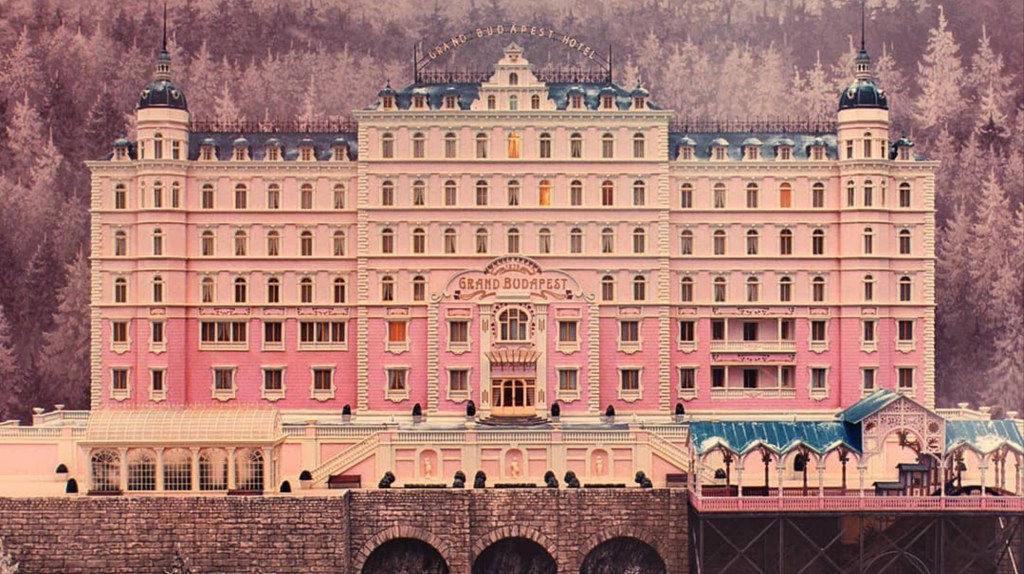
The aesthetic experience of watching his films transport nostalgia of an adult browsing the pages of a children’s storybook –though colorful and visually appealing, it exhibits a peculiar mood of drama as each page is revealed. Every shot is like a painting for its artistry and composition, undeniably frame-worthy. Wes Anderson and his creative talent in blending colorful visuals and heavy plot uncover a masterpiece.
To support the succeeding parts, three films of Wes Anderson are tackled: The Life Aquatic with Steve Zissou (Life Aquatic hereafter), Moonrise Kingdom, and The Grand Budapest Hotel (Grand Budapest hereafter).
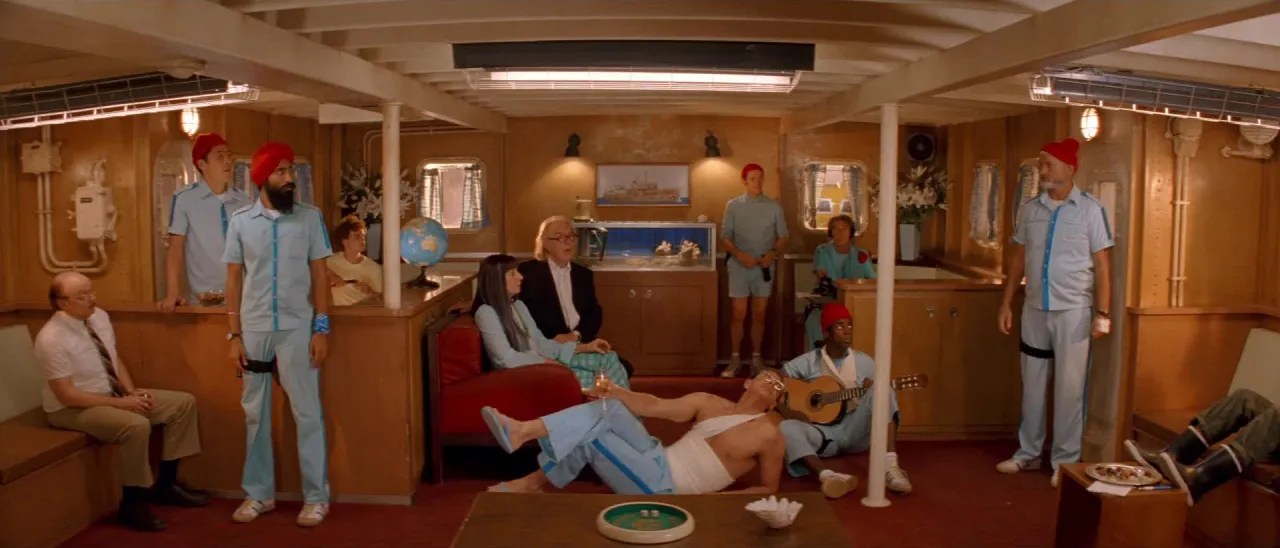
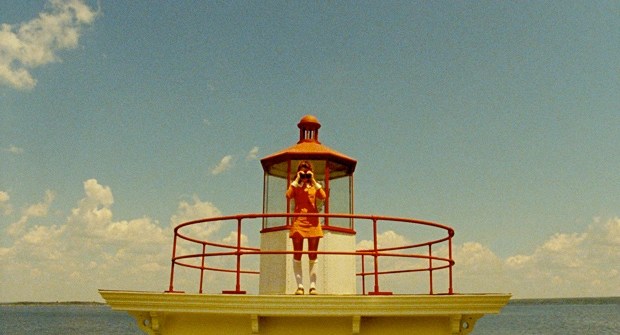
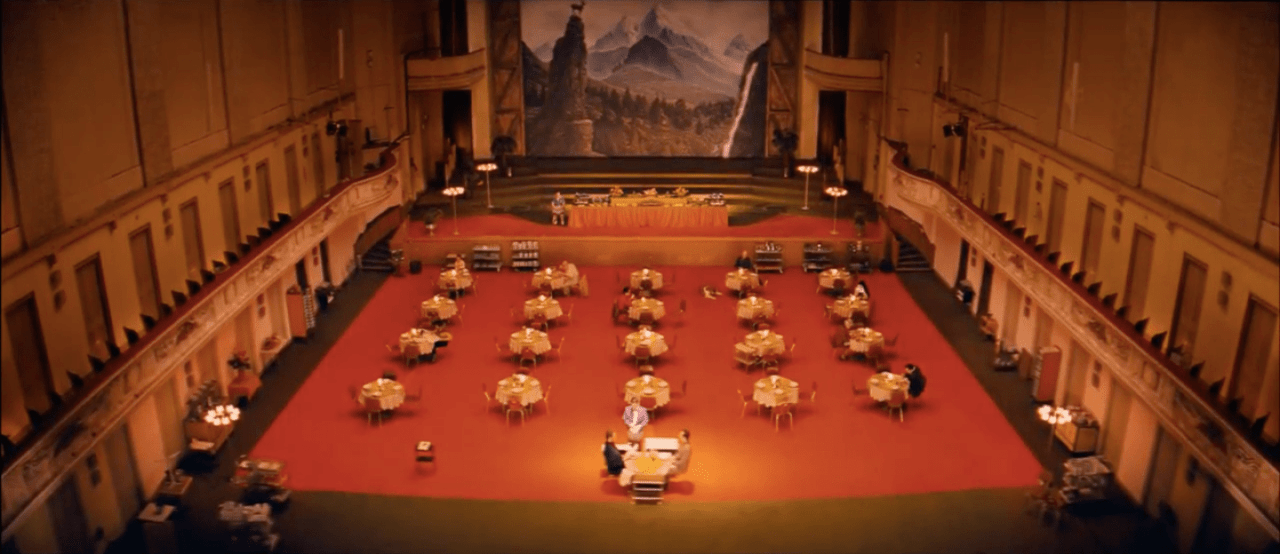
In terms of technical expertise, Anderson is particular with the composition of his shots. He has an exceptional talent in choreographing each scene. In the abovementioned films, every frame is well-composed: visually planned set decoration, costumes tailored fit with the actors –with every single actor appearing on screen, precise camera movements, musical score entering dramatically which eventually merges with the visuals, lines well delivered by actors every–single–time. He is capable of presenting a story in a theatrical perspective. Some may find his work “too colorful” or “too artsy”, but he is capable of blending everything…not only on certain scenes, but capable of blending every element in the whole film. Literally, he directs everything. There is careful maneuvering and fusion of movie elements in his works.
Personality wise, one of Anderson’s trademark includes consistency in casting same actors in his films: Bill Murray as Steve Zissou in Life Aquatic, Mr. Bishop in Moonrise Kingdom, and M. Ivan in Grand Budapest; Owen Wilson as Ned Plimpton in Life Aquatic and M. Chuck in Grand Budapest. Interestingly, he is also one of the writers and producers of his directed films. But Anderson is not only consistent in casting same actors, but also in his production team. In the abovementioned three films: Robert Yeoman is the Director of Photography, Randall Poster is the Music Supervisor, and Casting by Douglas Aibel. On the other hand, two from the abovementioned films have Adam Stockhausen as Production Designer, Milena Canonero as Costume Designer, and Original Music by Alexander Desplat. Looking into the same production team, this may explain why Anderson’s style is omnipresent in his works.
The photography of his films celebrates central focal point rather than the universal rule-of-thirds. In these three films, he was consistent in using mid-concentrated shots in almost every scene, whether it may be a long shot or close-up. Even in long shots, Anderson makes sure that there is always a center focus for succeeding close-up pans or zooms. In other shots, though there is heavy panning, it all ends in the center. Notice too that Anderson’s films are almost always two-dimensional, or flat. But because of the picturesque set composition, there may be no point of using three-dimensional shots. His style of panning and zooming are also consistent, based on the aforesaid films, he never used diagonal panning –again, this supports two-dimensional style.
Noticeably, Anderson uses red and yellow in his movies: red, yellow, and blue in Life Aquatic; red, yellow, and green in Moonrise Kingdom; and red, yellow, and purple in Grand Budapest. Without watching his films, some may think it’s an eyesore to overly abuse same colors in almost every scene… but Anderson is undeniably good in this. He maximizes color to unify the whole film, and barely uses other tones to represent other locations or unusual and climactic scenes presented. In Life Aquatic, he used shades of grey, light brown and mint green in the chase and hunting scene where Team Zissou wore grey diving suits. On the other hand, royal blue was used in Moonrise Kingdom specifically in the secret small talk between past lovers Mrs. Bishop and Captain Sharp, and also in the raining night scene where Sam and Suzy planned to jump off the church steeple. Lastly, shades of grey were used in Grand Budapest specifically in the prison location and the snow chase scenes. Although there are dominant colors in these films, Anderson’s splat of different tones balanced the films’ color palette.
He is also fond of set location showcase. Moonrise Kingdom begins with a framed cross-stitched shot of Bishop’s house also called as Summer’s End, followed by the panning of the different parts of the house, and the intro finally ended with a long shot of the house –the image in the framed cross-stitch itself. Then, a random guy in a red coat later introduced succeeding locations of Sam and Suzy’s trail, in a documentary style of narration. Life Aquatic on the other hand, had a showcase of the boat that team Zissou used –the Belafonte. It explained the function of every room in the Belafonte. In Grand Budapest, narration of scenes revealed different locations of the hotel. Going back to the children’s storybook browsing, Anderson creatively makes the audience understand and appreciate the set and the location of the scenes.
Aside from location shots, characters were also introduced –usually through the narration of one of the actors. Steve Zissou was able to introduce the Zissou crew through the documentary The Life Aquatic. In Grand Budapest, the old Zero introduced the characters through narration. In Moonrise Kingdom, no character introduction was used though the camera panned in almost all of the corners of the Bishop residence, as presentation of the family.
In the abovementioned films, paintings are always involved. In Life Aquatic, framed acrylic paintings are hanged in some parts of the Belafonte boat. There is also a scene where the Steve Zissou’s portrait is displayed in the Explorer’s Club. Hanged paintings are also seen all over the walls of Summer’s End in Moonrise Kingdom. Also, one of the lead characters, Sam, is an artist. He sends his sketches to Suzy, and even sketched Suzy when they escaped –or should we say, when they had “pre-elope attempt”. The movie ended with a shot of Sam’s Moonrise Kingdom painting at Suzy’s place. Lastly, the controversial Boy With Apple painting is significant in the plot of Grand Budapest.
Lastly, it is not a Wes Anderson film if there is no use of text or graphics. Text is used to introduce a character’s name, year, place, or event. Graphics such as maps or close-ups of letters are also consistent in Anderson films. In Moonrise Kingdom, exchange of letters between Suzy and Sam were used in the montage of the scenes as the letters were narrated. Maps were also used to give a picture of where these two young lovers planned to go. Grand Budapest on the other hand, used graphics through letter focus, document focus, and even typography and design elements present in the patisserie box. Heavy use of text is present in Life Aquatic, it also used focused on letters, and text for location labeling.
Since the technical and personality facet of Wes Anderson films were discussed, the author shall now look into the interior meaning. Fueled with visual artistry, Anderson is meticulous in his mise-en-scène, ensuring wonderful blend of elements in every scene. The aesthetically appealing composition of shots balances the supposed to be melodramatic plot.
In Life Aquatic, revengeful Steve Zissou chases the “jaguar shark” which swallowed his best friend Estevan; but ended up in the discovery of his abandoned son Ned –who in the end, like Estevan, died in Steve’s presence. Moonrise Kingdom is the chase of Sam and Suzy. Unknowingly, both of them search for acceptance, which they found in each other’s company as they escaped their known families in search of the place they eventually called Moonrise Kingdom. In Grand Budapest, M. Gustave and Zero were chased for the supposed to be inherited Boy With Apple painting; yet M. Gustave and Zero found respect in a father-son like relationship as the chase ended. These films exhibited chase within a chase –chases that involved hurting and death, yet Anderson was able to celebrate these melancholic sentiments through his expertise.
It is interesting how Anderson is skilled in crafting every scene into a colorful scenario through his visual representations, but it is more interesting how Anderson alters melodramatic and tragic scenes into artistic masterpieces. Maybe… it is the élan of the soul.
 rastle.xyz
Leave a comment